
When the Four Pillars Came to Life
Last night, The Parathist stopped being simply an idea I had been building and became something I could watch unfold in a room full of people.
When I created The Parathist, I identified four pillars that represent the way I approach this work: Intuition, Investigation, Connection, and Hope.
I knew what those words meant to me. I knew why I had chosen them. But during last night's gallery reading, I had the opportunity to watch all four come together.
And it began before I ever entered the room.
Intuition
Before a reading or investigation, I take time to pay attention to what I am experiencing intuitively. I don't research the people who will be attending, and I don't try to make the information fit a particular story.
I simply document what comes through.
Words. Images. Relationships. Sensations. Phrases. Sometimes very specific details. Sometimes fragments that make absolutely no sense to me at the time.
The photograph below is one of the actual pages I wrote before arriving at the gallery reading.
Intuitive impressions documented before the October 3, 2026 gallery reading.
I didn't know who these notes belonged to—or whether they would mean anything to anyone at all.
That's important.
For me, intuition isn't about immediately declaring that something is correct. It is about receiving information, documenting it, and allowing what happens next to determine whether there is a connection.
Investigation
This is where the investigator in me takes over.
Once something has been documented, I become curious about what happens when that information is presented.
Does someone recognize it? Can they identify the relationship? Does another piece of information strengthen the connection? Is there something specific enough that the person receiving the reading can validate it?
Or does it simply go nowhere?
I'm comfortable with that last possibility.
Not every impression has to become something. In fact, allowing information to remain unresolved is part of what makes this process meaningful to me.
During last night's gallery, however, many of the impressions did find their connections.
Guests described portions of their readings to me as “spot on.” Details that had made little sense when I originally wrote them began to have meaning when the people receiving them provided the context I didn't have.
And I had another page of notes waiting.
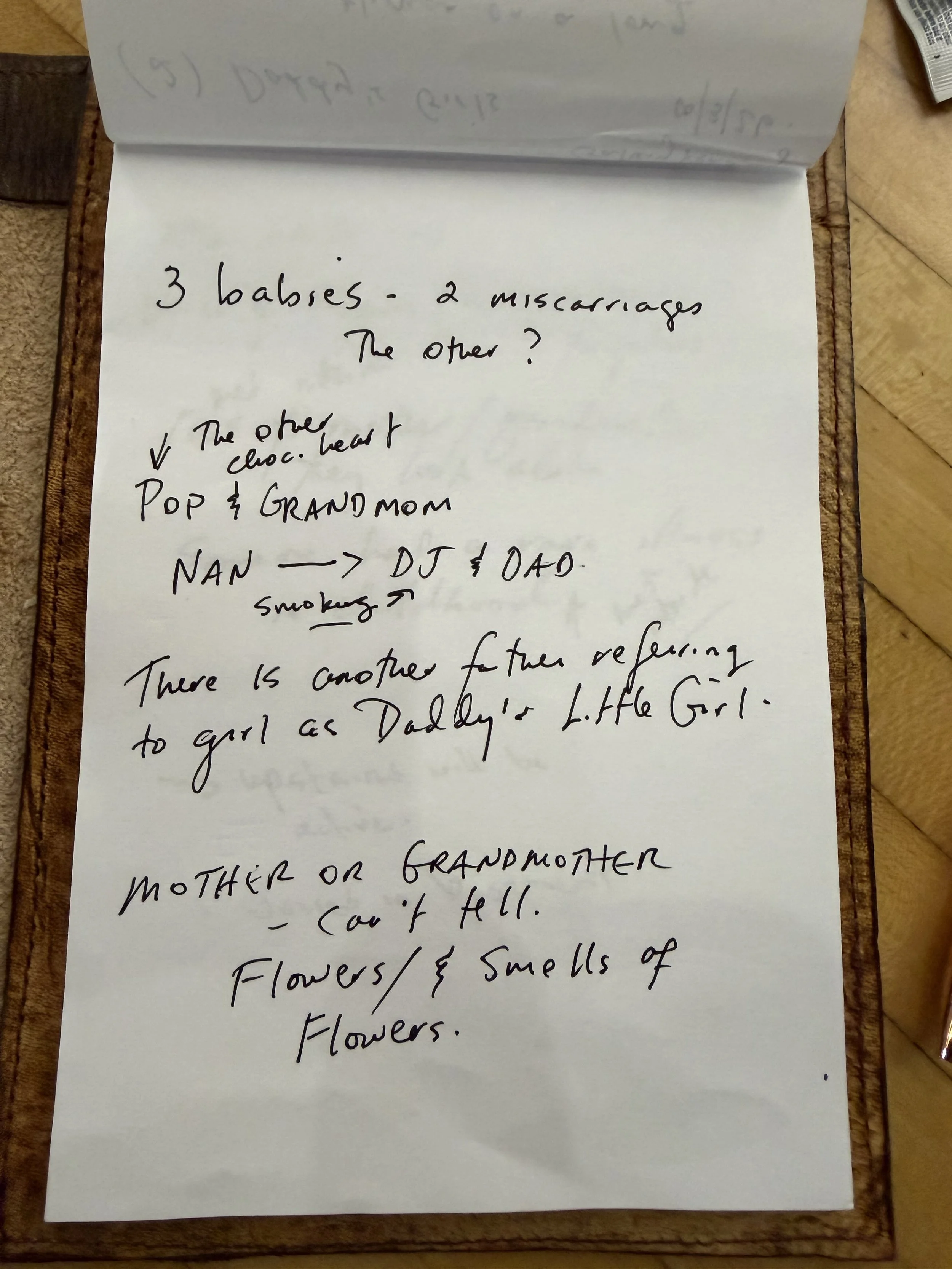
Additional intuitive impressions documented before the October 3, 2026 gallery reading.
Looking back at these pages after the gallery ended felt very different from writing them beforehand.
Before the reading, they were fragments—names, relationships, images, sensations and thoughts that I couldn't fully explain. Afterward, some of those same fragments carried context that I simply did not have when I wrote them.
That is why documenting this process matters so much to me.
I don't want to rewrite an impression after I understand it. I don't want to make a detail fit because I now know the story. I want to preserve what I experienced when I experienced it—including the questions, the uncertainty and the pieces that may never find an explanation.
There is something powerful in being able to return to the original page and see exactly where the experience began.
Last night reminded me that investigation doesn't diminish intuition by questioning it. For me, it gives intuition structure. It asks me to remain curious, accountable and willing to let the information speak for itself.
That is where intuition meets investigation.
Connection
Connection was where the evening became much more personal.
Throughout the gallery, there were moments when information seemed to be recognized almost immediately. A word, relationship, memory or detail would be communicated, and I could sometimes see the recognition before anyone said anything.
Guests told me that readings were “spot on.” There was laughter, surprise and, at times, a great deal of emotion. People cried. Others offered support to one another. The atmosphere in the room shifted as different connections unfolded.
I want to be careful about how I describe those moments, because I don't want to assign meaning to someone else's emotional response. Tears do not automatically tell me what another person is experiencing, nor does recognition alone answer every question about what is happening during mediumship.
But I am curious about it.
What happens when a piece of information that means very little to me carries significant meaning for someone else? What happens when several details seem to point toward the same person or relationship? And what do we make of those moments when recognition appears before I understand why the information matters?
Those questions are part of this work for me.
As the medium, I can describe what I experience. I can document information beforehand. I can communicate what comes through. The person receiving the information brings something I don't have—the memories, relationships and lived experiences that give those details context.
Somewhere between those two perspectives, connection happens.
I don't believe I need to define that connection for someone else in order to respect its significance.
Sometimes the most responsible thing I can do is remain present, remain curious, and allow the person receiving the message to decide what it means to them.
Hope
Hope may be the most difficult of the four pillars to describe, because it asks me to acknowledge something meaningful without deciding what that meaning should be for someone else.
Last night, I watched people cry. I watched them laugh. I saw expressions change as memories surfaced and connections were recognized. There were moments that appeared deeply emotional, and moments when the atmosphere in the room seemed to become lighter afterward.
From where I stood, some of those moments felt healing.
But my role as a medium is not to determine that healing occurred, and my background in the mental health field makes that boundary especially important to me. An emotional response belongs to the person experiencing it. I can witness it, respect it and hold space for it without defining it.
What I can acknowledge is the possibility of hope.
Hope that remembering someone we have lost can bring comfort alongside grief. Hope that a meaningful connection—however someone ultimately understands or explains it—can remind us that love continues to have an impact long after a person is gone.
I don't think hope requires certainty.
It leaves room for questions. It leaves room for skepticism. It leaves room for belief. And it leaves room for each person to decide what an experience means to them.
Perhaps that is one of the things I took away from last night most strongly.
I entered the gallery with pages of handwritten impressions and no idea where many of them would lead. I left having watched strangers recognize memories, laugh together, cry together and support one another as those pages slowly acquired meaning.
I don't need to explain every part of that experience to recognize its significance.
I can remain curious.
And I can remain hopeful.
Last night, the four pillars of The Parathist weren't words on my website anymore.
They were happening in front of me.
Intuition began the question.
Investigation examined what emerged.
Connection gave it personal meaning.
And hope was what remained afterward.
For my first gallery reading as The Parathist—and my first entry in this Journal—I can't think of a more appropriate place to begin.
Where intuition meets investigation.